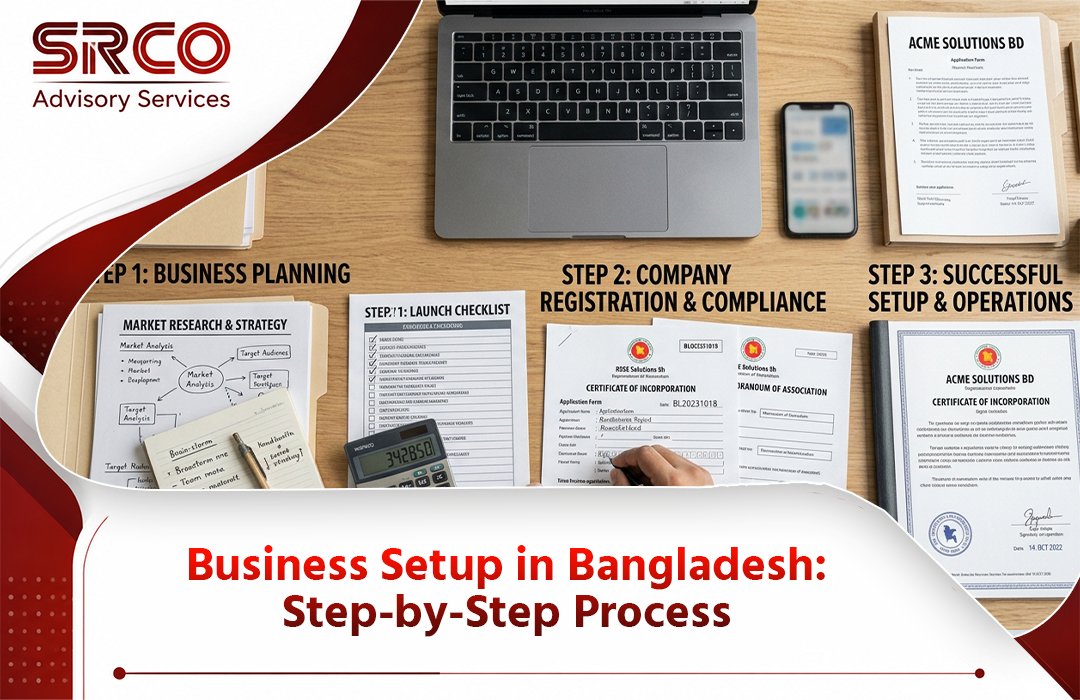
Bangladesh’s growing economy, strategic location in South Asia, and competitive labor costs make it an increasingly attractive destination for entrepreneurs and foreign investors alike. Yet setting up a business here requires navigating a defined regulatory pathway involving several government agencies. This step-by-step guide breaks down the entire business setup process in Bangladesh so you can plan your market entry with clarity and confidence.
Before any paperwork begins, you need to determine which legal structure best fits your goals. Options include a sole proprietorship, partnership, private limited company, public limited company, or a branch/liaison office for foreign parent companies. A Private Limited Company remains the most popular choice, as it offers limited liability and is well-suited for both local entrepreneurs and foreign investors seeking full or partial ownership.
Business setup formally begins with a name clearance application through the Registrar of Joint Stock Companies and Firms (RJSC). The chosen name must be distinct from existing registered businesses and compliant with naming guidelines.
This stage involves drafting the Memorandum of Association (MoA) and Articles of Association (AoA), which set out the company’s purpose, authorized capital, and governance structure. Foreign investors will also need to prepare notarized copies of passports, board resolutions, and, in some cases, an encashment certificate confirming inward remittance of capital.
Once documents are finalized, they are submitted to RJSC along with the prescribed registration fee (calculated based on authorized share capital). Upon successful review, RJSC issues the Certificate of Incorporation, officially establishing the company as a legal entity in Bangladesh.
Every business entity must obtain a Taxpayer Identification Number (TIN) from the National Board of Revenue (NBR). If your projected turnover exceeds the VAT registration threshold, or if you operate in a sector requiring mandatory VAT registration, you must also register with the VAT wing of NBR and obtain a Business Identification Number (BIN).
A trade license from the relevant City Corporation, Municipality, or Union Parishad is mandatory for conducting commercial activity. This license must be renewed annually and is often required to complete bank account opening and other regulatory registrations.
Foreign-owned or joint-venture companies must register with the Bangladesh Investment Development Authority (BIDA), which facilitates work permits, remittance approvals, and various investor facilitation services. BIDA registration is a critical step for companies bringing in Foreign Direct Investment (FDI).
With incorporation documents, TIN, and trade license in place, the company can open a corporate bank account. For foreign investors, capital must typically be remitted through this account and reported to Bangladesh Bank to obtain the encashment certificate needed for BIDA and RJSC compliance.
If you plan to hire staff, you will need to comply with the Bangladesh Labour Act, including employee registration, provident fund arrangements (where applicable), and workplace safety requirements.
Business setup does not end at incorporation. Companies must file annual returns with RJSC, submit periodic VAT returns, file corporate income tax returns, and maintain statutory books of accounts. Non-compliance can result in penalties or complications during future audits or fundraising.
A straightforward business setup in Bangladesh, with complete documentation, can typically be completed within four to eight weeks. Costs vary depending on authorized capital, sector-specific licensing, and whether the business involves foreign shareholders, but professional advisory support can help avoid costly delays and rejected applications.
Business setup in Bangladesh follows a clear, multi-agency process — but successfully navigating it requires attention to detail and up-to-date regulatory knowledge. Working with an experienced local advisory firm ensures your company is incorporated correctly, remains compliant, and is positioned for sustainable growth in one of South Asia’s most dynamic markets.
Blogs