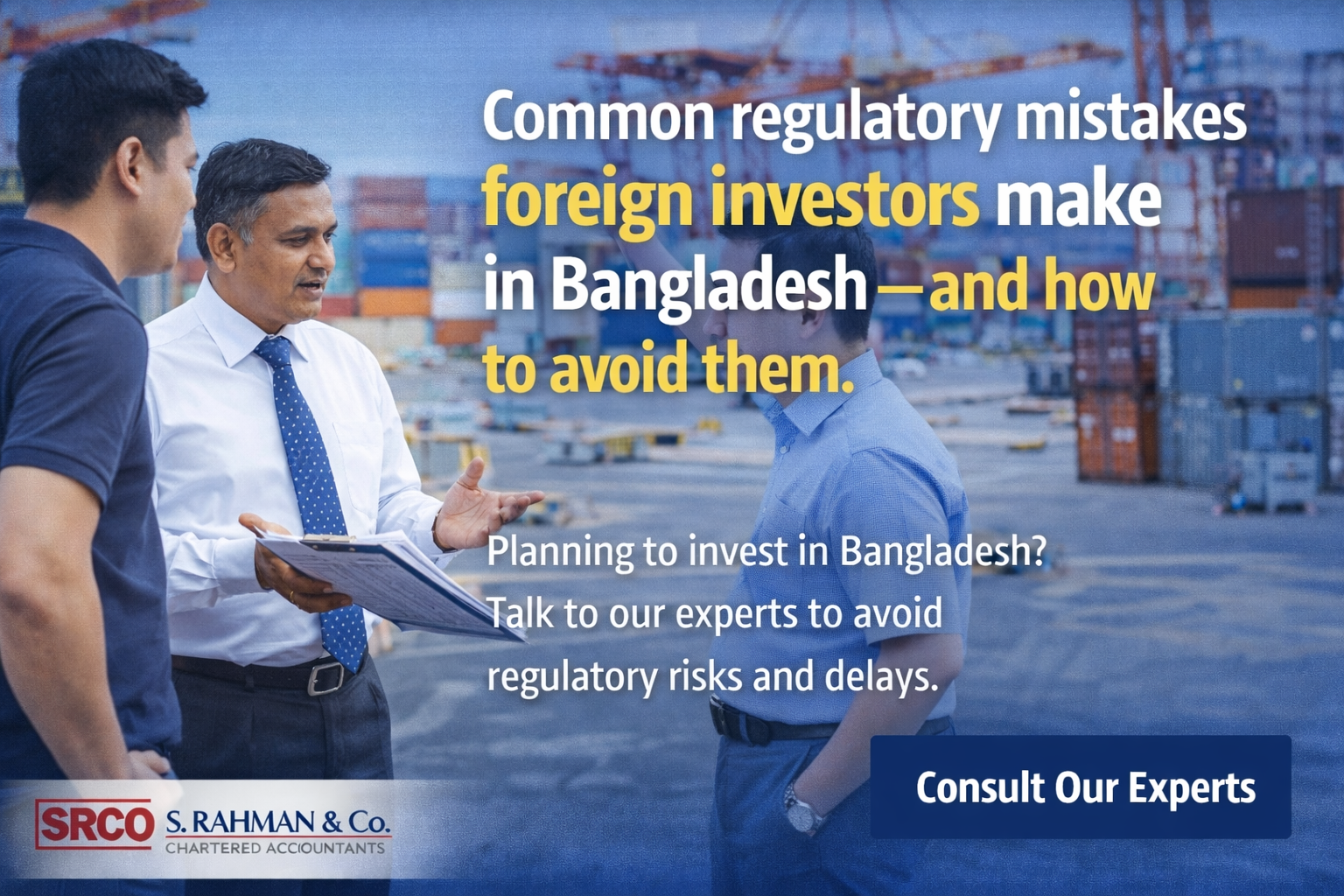
Bangladesh has emerged as a promising destination for foreign direct investment (FDI), particularly in manufacturing, RMG, infrastructure, energy, logistics, and trading sectors. Competitive labor costs, preferential trade access, and a growing domestic market make the country attractive to foreign investors.
However, many foreign investors—especially first-time entrants—face serious regulatory challenges due to unfamiliarity with local laws, procedures, and institutional practices. These mistakes often result in cost overruns, delays, penalties, or even exit difficulties.
At S. Rahman & Co., Chartered Accountants, we regularly advise foreign investors and have identified the most common regulatory pitfalls—and how to avoid them.
One of the most frequent mistakes is selecting an inappropriate business structure at the outset.
Foreign investors often register a local limited company without properly evaluating whether:
A Branch Office
A Liaison Office
An EPZ / BEZA entity
Or a Joint Venture
would be more suitable.
Tax exposure may increase unnecessarily
Certain incentives may be lost
Exit and repatriation can become complicated
Solution:
Conduct a pre-investment feasibility and regulatory assessment before registration.
Many investors assume that company registration alone is sufficient to start operations. In reality, Bangladesh requires multiple approvals, depending on the sector.
Commonly overlooked approvals include:
Investment registration with BIDA / BEZA / EPZ Authority
Sector-specific permissions
Customs bond licensing for exporters
Environmental clearance
Factory and labor-related registrations
Operational delays
Bank account opening issues
Customs clearance problems
Solution:
Prepare a regulatory roadmap covering approvals, timelines, and dependencies.
Foreign investors frequently rely on home-country tax assumptions, which often do not align with Bangladesh’s tax framework.
Common mistakes include:
Incorrect VAT registration or classification
Non-compliance with withholding tax
Improper transfer pricing documentation
Poor record-keeping for audits
Penalties and interest
Disallowed expenses
Increased scrutiny by tax authorities
Solution:
Adopt Bangladesh-compliant tax planning aligned with IFRS and local laws.
This is particularly common among manufacturing and export-oriented investors.
Mistakes include:
Starting import/export operations without customs bond approval
Incorrect bond utilization
Lack of reconciliation between production, export, and inventory
Customs penalties
Suspension of bonded facilities
Operational shutdowns
Solution:
Ensure customs bond planning is integrated into the investment and operational setup.
During acquisitions or ownership transfers, many foreign investors rely on generic or overseas SPA templates.
Key risks include:
Inadequate protection against historical tax liabilities
Weak indemnity clauses
Regulatory non-compliance with local laws
Post-acquisition disputes
Hidden liabilities
Delayed ownership transfer approvals
Solution:
Use locally compliant SPAs aligned with Bangladesh laws and regulatory expectations.
Some investors limit due diligence to financial statements only, overlooking:
Tax exposures
Regulatory non-compliance
Labor and environmental risks
Title and land ownership issues
Unexpected liabilities
Difficulty in transferring title or shares
Future compliance risks
Solution:
Conduct comprehensive financial, tax, and regulatory due diligence before investment.
Foreign investors often fail to maintain:
Proper board resolutions
Statutory registers
Share transfer documentation
Regulatory filing records
Problems during audits
Regulatory penalties
Issues during exit or restructuring
Solution:
Establish strong corporate governance from day one.
Many investors focus heavily on entry but ignore exit planning.
Common issues:
Non-compliant capital structure
Unclear dividend policy
Improper documentation for profit repatriation
Delays in fund repatriation
Bangladesh Bank objections
Reduced investor confidence
Solution:
Design investment structures with clear exit and repatriation mechanisms.
At S. Rahman & Co., Chartered Accountants, we act as a single-point advisory partner for foreign investors by offering:
Investment structuring & feasibility advisory
Regulatory approvals & compliance roadmap
Financial, tax, and regulatory due diligence
SPA and ownership transfer support
Ongoing accounting, tax, and CFO services
Our approach ensures regulatory certainty, cost control, and long-term sustainability for foreign investments in Bangladesh.
Bangladesh offers strong investment potential—but success depends on regulatory awareness and proper planning. Most costly mistakes are preventable with the right local guidance.
Foreign investors who approach Bangladesh with professional advisory support significantly reduce risk and accelerate growth.
If you are planning to invest, acquire, or expand operations in Bangladesh, contact S. Rahman & Co. for trusted, investor-focused advisory services.
Blogs